Saturday, December 1, 2007

Extraterrestial Summit in Lajas, PR


(if you click on the photo above you should be able to see read the article, which is priceless)

I have always wondered about the obsession with extraterrestials that seems to prevail among sectors of my fellow Puerto Rican population. Whenever I visit, I am mesmerized by the wide variety of OVNI or UFO-related periodicals avaiable at the check-out line at the local PUEBLO supermarket or Farmacia Moscoso racks. From my childhood I recall being terrified by stories of the hybrid monster the garadiabolo and more recently we heard about the chupacabras. There are also the stories of UFO landings all over the Island that are somehow linked to it being in the Bermuda Triangle. And now I have belatedly learned that since 2005 a gentleman in Lajas has taken it to the next level, making plans for an OVNIPUERTO and today he is hosting a summit for those who have like him had contact with those from outer space.


I accidentally came across this hysterical bit of real news when I was on the El Nuevo Dia website reading local news from the Island, which of course then led me to You Tube. There, I found a terrifying but apparently not fake piece of footage from a show called "A Calson Quitao" where three men are discussing - with a total lack of irony I might add- the logistics for establishing said OVNIPUERTO on the Island:

http://www.youtube.com/watch?v=n175BBi28eY

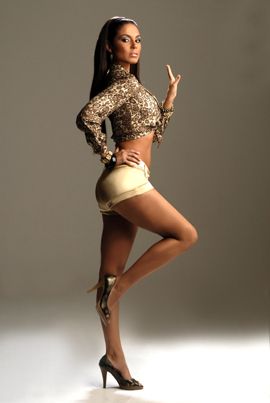
Miss Puerto Rico Places Within Top 15 in Miss World Pageant


Breaking News:
Miss Puerto Rico, Jennifer Guevera, placed in the top 15 finalists for Miss World. Here she is, proving my point that, for Puerto Ricans, metallics and animal prints are neutrals.

Friday, November 30, 2007

Is This Why Chavez Wants to Police the Names Given to Kids in Venezuela?

Anyone who has read this blog knows that I am fascinated by what the NY Times calls "the culture of naming" in Latin America. The German, French or faux composite Spanish/French/German names spelled in a hybrid Spanish manner of some of my Puerto Rican relatives, those I read on name tags at the Asssociated Super Market, or see on the screen while watching Miss Universe...they all obsess me. Reyna, Yesenia, Jeanmarie, Delorean, Elvis, Harold, you name it! And now in Spain, too, my compatriots name their children Yonatan, or Yenifer. Fabulous.

Thanks to Simon Romero in Caracas, we learned that the dictator Chavez wants to curtail such practices and limit approved Revolutionary Bolivarian names to a set list. (see below under Real News/Miss Universe). His disgruntled Congressman Iroshima Perez is offended. And now we learn that the leader of the student group opposing the regime is named STALIN Gonzalez. Obviouly, this is pronounced EHS-TAH-LEEN. You cannot make this stuff up. Realismo Magico at its best. And I have been told by my beloved Venezuelan friends that there are cases of telenovela writers who are also avant-garde theatre authors with names like IBSEN (that would be their first name of course). I remember meeting a man from Peru who went by the first name LENIN. So the heroic student leader Stalin isn't an exception.

The Wall Street Journal

To Oppose Chávez, Youth In Caracas Rally Behind Stalin
That's Ivan Stalin González, Student-Movement Leader; A Broad Dissent on Campus
By JOHN LYONS and JOSÉ DE CÓRDOBA
November 24, 2007; Page A1

CARACAS, Venezuela -- As Venezuelan President Hugo Chávez attempts to push through what he calls 21st-Century Socialism, his biggest obstacle is an army of students led by a leftist named Stalin. Ivan Stalin González, who prefers to be called just plain Stalin, is president of the student body at the Central University of Venezuela, or UCV, Venezuela's biggest public university. During the past few weeks, Mr. González and other student leaders here have organized protest marches by tens of thousands of students opposed to a constitutional referendum set for Dec. 2. The proposed changes would dramatically expand Mr. Chávez's power and allow him to seek perpetual re-election.

The student movement has taken the government by surprise, highlighting an embarrassing irony for the fiery Mr. Chávez: University students, long a bastion of the left here as in the rest of Latin America, are overwhelmingly opposed to him. They have also emerged, along with the Catholic Church, as among the last major opposition to Mr. Chávez in a country where he already controls the congress, courts, army and most media outlets.

Students like Mr. González have traditionally played an outsized role in Latin America's turbulent politics. In the 1950s, University of Havana students led a struggle against Cuban dictator Fulgencio Batista. Fidel Castro, who forced Mr. Batista from power -- and who is Mr. Chávez's revered mentor -- got his start as a student leader at the university. In Mexico, a massacre of students and other protestors in 1968 helped inspire the creation of half a dozen small guerilla groups in the 1970s. And in Venezuela, UCV holds an important place in political history. In 1957, a student strike that began here eventually led to the downfall of dictator Marcos Pérez Jiménez. Half a century later, many Venezuelans hope Mr. Chávez will meet his political Stalingrad at UCV. "Student struggles have always preceded great historical changes," says Fernando Ochoa, a former defense minister who was jailed when he participated in the 1957 strike as a high school student.

Anti-Chávez sentiment on Venezuelan campuses burst into the open in May, when the government pulled the plug on RCTV, a television network critical of Mr. Chávez. Tens of thousands of students viewed the move as a blow to freedom of speech. They were also alarmed by Mr. Chávez's promises that the "revolution within the university" would be next -- likely expanding government control over areas like the curriculum. They took to the streets, creating a protest movement in campuses across the country. The Dec. 2 referendum has sparked a round of new protests. Caught off guard, Mr. Chávez has called the students "terrorists" and written them off as "pampered, rich mama's boys." UCV, which charges no tuition, has a range of students, from the scions of businessmen to the sons of taxi drivers.

Mr. Chávez's description also hardly fits Mr. González. The 27-year-old, sixth-year law student grew up in a poor household that dreamed of a Communist Venezuela. His father, a print-machine operator, was a high-ranking member of the Bandera Roja, or Red Flag, a hard-line Marxist-Leninist party that maintained a guerrilla force until as recently as the mid-1990s. Its members revered Josef Stalin as well as Albania's xenophobic Enver Hoxha. As a boy, Mr. González remembers packing off to marches with his sisters, Dolores Engels and Ilyich, named in honor of Vladimir Ilyich Lenin. As a young man, Mr. González burnished his leftist credentials, joining Marxist youth groups and following his father into the Bandera Roja. He traveled to Socialist youth conferences in Latin America. Mr. González was still in his teens when Mr. Chávez was voted into office in late 1998. Even then, he says, he was skeptical about Mr. Chávez's socialist rhetoric, as are many Venezuelan leftists. Mr. Chávez, a lieutenant colonel who had staged an unsuccessful coup attempt in 1992, would be more authoritarian than egalitarian, Mr. González reasoned.


URL for this article:
http://online.wsj.com/article/SB119586925917802724.html

Breaking News! The Pollocks Are Fake!


The totally Nerdolicious and charismatic forensic scientist James Martin wittily proves beyond the shadow of a doubt that there is something the Matter with the Pollocks!!!

If you want the straight story, the cache of alleged Jackson Pollock works found by the son of artists who were friends with the late Abstract Expressionist has been disputed for years, generating controversies among art historians, gallerists, curators, conservators, scientists and lawyers. Many of the disputed works are on view at the Boston College Museum in a show called Pollock Matters. But at a Standing Room Only panel organized by the International Foundation for Art Research, which I was extremely fortunate to attend, a leading expert on Pollock and two scientists raised serious questions against the attribution.

Here is the link to the NYTimes article:

Scientist Presents Case Against Possible Pollocks
By RANDY KENNEDY
Published: November 29, 2007
A large group of paintings discovered several years ago and thought by some to be by Jackson Pollock included many containing paints and materials that were not available until after the artist’s death in 1956.
For full story:
http://www.nytimes.com/2007/11/29/arts/29pollock.html?ex=1354078800&en=e6e960a6e1929ed1&ei=5124&partner=permalink&exprod=permalink

The brilliant art historian and Pollock expert Pepe Karmel began the evening's lectures by demonstrating that the focus on materials since the works were first unveiled means that the issue of connoisseurship has been overlooked. He showed how, looking carefully at the color, composition, application of paint, and condition of the works, one can compare those with Matter provenance to known Pollocks and find notable differences between the two. Giving very specific examples, he demonstrated why there is something the matter with the Matter pictures which look like the work of someone who has taken Greenberg's paradigm of "all overness" literally, there are problems with scale, with the grounds used, and many other issues.
The works look more like Herbert Matter's known pictures than Pollock's, so, he suggested, could they be works by Matter experimenting "in the manner of Pollock"?

Then Richard Newman, a scientist from the MFA Boston spoke, he was very impartial in tone and summarized various studies conducted by scientists on these works.

Finally, James Martin presented for the first time the results of his research. He had allegedly been threatened with lawsuits if he spoke publicly about his research. This of course made listening to its unveiling all the more exciting. Martin, who works with the FBI among other institutions, combined police-type research, interviews, and the like, with hundreds of scientific tests. He enraptured the entire room, you could hear a pin drop, and there were gasps as he developed his arguments. It was like a live artworld version of CSI!!! Who knew that science could be so exciting? It is when a life-or-death issue is at stake: do we or do we not have a new body of work by one of the canonized Masters of American art? If so, how many millions are they worth?

Martin went over many inconsistencies in Alex Matter's stories regarding the date(s) the works were found and the location(s) where they were found. He also mentioned that he examined the warehouse records of the storage where they were found and that Matter and his mother had access to the space (this led me to ask if they knew the works were there all along or perhaps placed them there after Herbert Matter died?) He conclusively showed that the boards used in some of these works were not produced until the mid 1970s, he also discussed at length the pigments. Most of those were from the mid-1970s or later. Then and thankfully using layman's terms as much as he could, he explained why he learned that many of the works include these pigments from the 1970s-80s at the lowest layer, and then are covered over with pigments available starting in the 1960s. Some of these pigments available only as of the 1970s are used for the initials "JP" in some works. He added that for some, this type of situation may raise questions of intentional misattribution and fraud.

Of course, to my recollection, all three were careful not to literally say that the works are fake, but they presented scholarly arguments that convinced me for one, that they are.

I felt like I had been a witness to a historic event that will be part of art history.

Thursday, November 29, 2007

Am I a Masochist? Miss PR Universe Asks

Update:
On Wed. news broke that several people questioned whether Ingrid Marie was actually attacked. Some called it a hoax.

She appeared on the TODAY show, hopefully the video URL below will be permanent. Don't miss the Second Runner Up, who looks like an understudy for the Rocky Horror Picture Show.


Update:
On Saturday, news broke that THERE WAS NO PEPPER SPRAY on either her gown or her make up brush!

Tuesday, November 27, 2007

"Am I a masochist?" new Miss Puerto Rico Universe Asks


Yesterday international wire services ran the spectacular story from Puerto Rico - the top contender for the Miss Puerto Rico Universe title, 24 year old Ingrid Marie Rivera, was doused with pepper spray introduced into her clothes and make-up. Attack of hives and itching notwithstanding, Ingrid Marie rocked it. Without losing her professional compusure, she stepped up on stage, finished her desfile, ran backstage, applied ice to the affected areas to combat the attack, and took the win that will lead her to represent us in the Miss Universe pageant. This news coverage has allowed my friends and me to enjoy reading the typical Islander names mentioned in the coverage, note that the queen is called Ingrid Marie, the use of German, French and English names is prevalent, thus the PR rep for the police is called Stephen Alvarez, the agent in charge Erick Vazquez, the head of the pageant, Harold Rosario. Then we have what I would call the "creatively capitalist-inflected names" such as that of Miss Arecibo: Delorean Torres. Clearly, she was born in the mid-eighties, and her parents were car buffs.


At the press conference following her win, Miss PR Universe asked rhetorically "Am I a Masochist?" in true telenovela fashion. Today's Island papers breathlessly explain that a police investigation is underway since besides the attack on Ingrid Marie, there was a bomb threat called in. When I was a kid, the bomb threats were made by pro-Independence guerrillas or allegedly staged by Romero Barcelo's government to make the independentistas look guilty. It seems that now the struggle is to represent the Island on the international stage that is Miss Universe. El Nuevo Dia also boasted that the story has received international coverage. Last night, I saw this story run on both BBC America (following a story about Chavez's sham vote to turn Venezuela into a Socialist dictatorship) and then on Anderson Cooper 360. AC seemed fascinated by the story, like any self-respecting gay man, and underscored Ingrid Marie's sang froid. But I wondered: why is this the only time they talk about the Island over here? It's as if it doesn't exist. Intelligent and well-educated Americans - living in NY a city that has more Puerto Ricans than the Island itself - ask me if we have a Puerto Rican passport (ask artist Adal Maldonado, who cleverly invents his own), what currency we use, and other surreal questions. Countless people I speak to do not know that PR is a US colony. I see it appear sometimes in USAToday (the McDonald's of newspapers as an ex used to call it) beneath the states, as a "territory."

As the story below from Reuters notes, "Beauty competitions are important stuff in Puert Rico," noting that Islanders have the "autonomy" to send a Delegate to Miss Universe- but not however, to have voting representatives in Congress. Thus Islanders fighting in Irak did not have the right to vote for the President or Congressmen that sent them to die. Another little-known fact, imaginary American reader!

So, are we masochists? I ask myself, obsessing on our "win" in the international arena of Miss Universe, which temporarily distracts us from obsessing on the question of our status vis a vis the US? Staging plebiscite pageants with the contestants "Commonwealth" "Independence" or "Statehood" that are non-binding in the US government's eyes, and which indeed, are rarely even noted by the the US media. When we call ourselves "Estado Libre Asociado" - Free Associated State, but USA Today and the US government refers to us as a "territory." On BBC's "Globe Trekker" they refer to the Puerto Ricans living in NYC: "100 years ago, the US opened its borders to Puerto Ricans, granting them US citizenship." Nice shout out from one waning imperial colonizing power to another! As if the US suddenly decided to generously open its doors, when they took the Island by force and gave citizenship in 1917, just in time to get islanders to go to war as cannon fodder.

By the way, Miss Venezuela is our top competitor, they've won 4 times. But we've won 5 times (Marisol Malaret, 1970, Deborah Carthy-Deu, 1985, Dayanara Torres, 1993, Denise Quinones, 2001, and Zuleyka Rivera, 2006 )!!!


Puerto Rican wins beauty contest despite sabotage
Mon Nov 26, 2007 2:27pm EST
By John Marino

SAN JUAN, Puerto Rico (Reuters) - Someone doused her make-up and clothes with pepper spray, but Ingrid Marie Rivera put on a happy face and managed to win the beauty pageant that selected Puerto Rico's representative in the Miss Universe contest.

The 24-year-old from the town of Dorado was all smiles in front of the audience and judges during the competition, which ended on Friday when she beat 29 rivals. But backstage, she had to strip off her clothes and ice down her face and body to fight swelling and hives.

Pageant officials have vowed to get to the bottom of the attempted sabotage that tainted the pageant, an event that inspires passions in the U.S. Caribbean territory. Puerto Rico has produced five Miss Universe winners.

"It was a lot of sacrifice, and my tears were genuine," Rivera told reporters at a news conference on Sunday.

"At one point, I asked, 'Am I a masochist?' But I said regardless of the results, this is my goal. The more rocks there are in my path, the more thanks I will give to God for sustaining me."

Pageant organizers say they suspected a member of the team handling one of Rivera's competitors was responsible.

Magali Febles, director of the Miss Puerto Rico Universe Pageant, said the person behind the "vile act" was "from inside."

"I am going to investigate this until the final consequences. When we have everything, I will announce who the person is because someone with these instincts is capable of anything."

Organizers also said Rivera's bags, containing clothing and credit cards, were stolen, and that a bomb threat called in on Thursday forced the cancellation of some preliminary events. Police were investigating the bomb threat.

Beauty competitions are important stuff in Puerto Rico.

The ability to field a Miss Universe competitor from Puerto Rico, as well as Olympic sports teams, is a factor in the island's endless political debate, brought about by its status as a U.S. territory with aspects of a state and an independent country.

The events are widely watched, the winners are front page news and the local press is filled with speculation about favorites in the days prior to the competition.

(Editing by Cynthia Osterman)

© Reuters 2006. All rights reserved. Republication or redistribution of Reuters content, including by caching, framing or similar means, is expressly prohibited without the prior written consent of Reuters. Reuters and the Reuters sphere logo are registered trademarks and trademarks of the Reuters group of companies around the world.

Reuters journalists are subject to the Reuters Editorial Handbook which requires fair presentation and disclosure of relevant interests.

Saturday, November 17, 2007

Spanish Surnames Surge- Garcias Are Catching Up With Joneses

More from the NYTImes on the "culture of naming" in this case, about the encroaching list of Spanish surnames that appear on the US census of most common names. As someone with a so-called Hispanic surname, I find this very gratifying although my name doesn't appear in the interactive graphic (to go to the graphic, follow the permalink below). Now we're up to 13% (of those counted on the Census there must be millions more on the DL?) of the population, Lou Dobbs must be apoplectic over this. As usual with the NYTimes, buried within the text there is a completely absurd moment:

"As recently as 1950, more Americans were employed as blacksmiths than as psychotherapists." What, then, are we supposed to do with this factoid? Move to Buenos Aires, where there is "the highest ratio of psychologists and psychotherapists per person in the world"? (source: http://pn.psychiatryonline.org/cgi/content/full/37/10/15)

I can only hope that some of the Venezuelans with the names no longer approved by the dictator Chavez's Revolutionary Bolivarian Nomenclature (see below for post under Real News/Miss Universe) will find a means to emigrate to the US so that they can not only have "freedom" but also add to our percentage of Hispanic sunames: Iroshima Perez - welcome!
__________________________________________________________
In U.S. Name Count, Garcias Are Catching Up With Joneses

By SAM ROBERTS
Published: November 17, 2007
Step aside Moore and Taylor. Welcome Garcia and Rodriguez.

Smith remains the most common surname in the United States, according to a new analysis released yesterday by the Census Bureau. But for the first time, two Hispanic surnames — Garcia and Rodriguez — are among the top 10 most common in the nation, and Martinez nearly edged out Wilson for 10th place.

The number of Hispanics living in the United States grew by 58 percent in the 1990s to nearly 13 percent of the total population, and cracking the list of top 10 names suggests just how pervasively the Latino migration has permeated everyday American culture.

Garcia moved to No. 8 in 2000, up from No. 18, and Rodriguez jumped to No. 9 from 22nd place. The number of Hispanic surnames among the top 25 doubled, to 6.

Compiling the rankings is a cumbersome task, in part because of confidentiality and accuracy issues, according to the Census Bureau, and it is only the second time it has prepared such a list. While the historical record is sketchy, several demographers said it was probably the first time that any non-Anglo name was among the 10 most common in the nation. “It’s difficult to say, but it’s probably likely,” said Robert A. Kominski, assistant chief of social characteristics for the census.

Luis Padilla, 48, a banker who has lived in Miami since he arrived from Colombia 14 years ago, greeted the ascendance of Hispanic surnames enthusiastically.

“It shows we’re getting stronger,” Mr. Padilla said. “If there’s that many of us to outnumber the Anglo names, it’s a great thing.”

Reinaldo M. Valdes, a board member of the Miami-based Spanish American League Against Discrimination, said the milestone “gives the Hispanic community a standing within the social structure of the country.”

“People of Hispanic descent who hardly speak Spanish are more eager to take their Hispanic last names,” he said. “Today, kids identify more with their roots than they did before.”

Demographers pointed to more than one factor in explaining the increase in Hispanic surnames.

Generations ago, immigration officials sometimes arbitrarily Anglicized or simplified names when foreigners arrived from Europe.

“The movie studios used to demand that their employees have standard Waspy names,” said Justin Kaplan, an historian and co-author of “The Language of Names.”

“Now, look at Renée Zellweger,” Mr. Kaplan said.

And because recent Hispanic and Asian immigrants might consider themselves more identifiable by their physical characteristics than Europeans do, they are less likely to change their surnames, though they often choose Anglicized first names for their children.

The latest surname count also signaled the growing number of Asians in America. The surname Lee ranked No. 22, with the number of Lees about equally divided between whites and Asians. Lee is a familiar name in China and Korea and in all its variations is described as the most common surname in the world.

Altogether, the census found six million surnames in the United States. Among those, 151,000 were shared by a hundred or more Americans. Four million were held by only one person.

“The names tell us that we’re a richly diverse culture,” Mr. Kominski said.

But the fact that about 1 in every 25 Americans is named Smith, Johnson, Williams, Brown, Jones, Miller or Davis “suggests that there’s a durability in the family of man,” Mr. Kaplan, the author, said. A million Americans share each of those seven names. An additional 268 last names are common to 10,000 or more people. Together, those 275 names account for one in four Americans.

As the population of the United States ballooned by more than 30 million in the 1990s, more Murphys and Cohens were counted when the decade ended than when it began.

Smith — which would be even more common if all its variations, like Schmidt and Schmitt, were tallied — is among the names derived from occupations (Miller, which ranks No. 7, is another). Among the most famous early bearers of the name was Capt. John Smith, who helped establish the first permanent English settlement in North America at Jamestown, Va., 400 years ago. As recently as 1950, more Americans were employed as blacksmiths than as psychotherapists.

In 1984, according to the Social Security Administration, nearly 3.4 million Smiths lived in the United States. In 1990, the census counted 2.5 million. By 2000, the Smith population had declined to fewer than 2.4 million. The durability of some of the most common names in American history may also have been perpetuated because slaves either adopted or retained the surnames of their owners. About one in five Smiths are black, as are about one in three Johnsons, Browns, and Joneses and nearly half the people named Williams.

The Census Bureau’s analysis found that some surnames were especially associated with race and ethnicity.

More than 96 percent of Yoders, Kruegers, Muellers, Kochs, Schwartzes, Schmitts and Novaks were white. Nearly 90 percent of the Washingtons were black, as were 75 percent of the Jeffersons, 66 percent of the Bookers, 54 percent of the Banks and 53 percent of the Mosleys.

Terry Aguayo contributed reporting from Miami.


http://www.nytimes.com/2007/11/17/us/17surnames.html?ex=1353042000&en=ec5870741a27e1e1&ei=5124&partner=permalink&exprod=permalink